

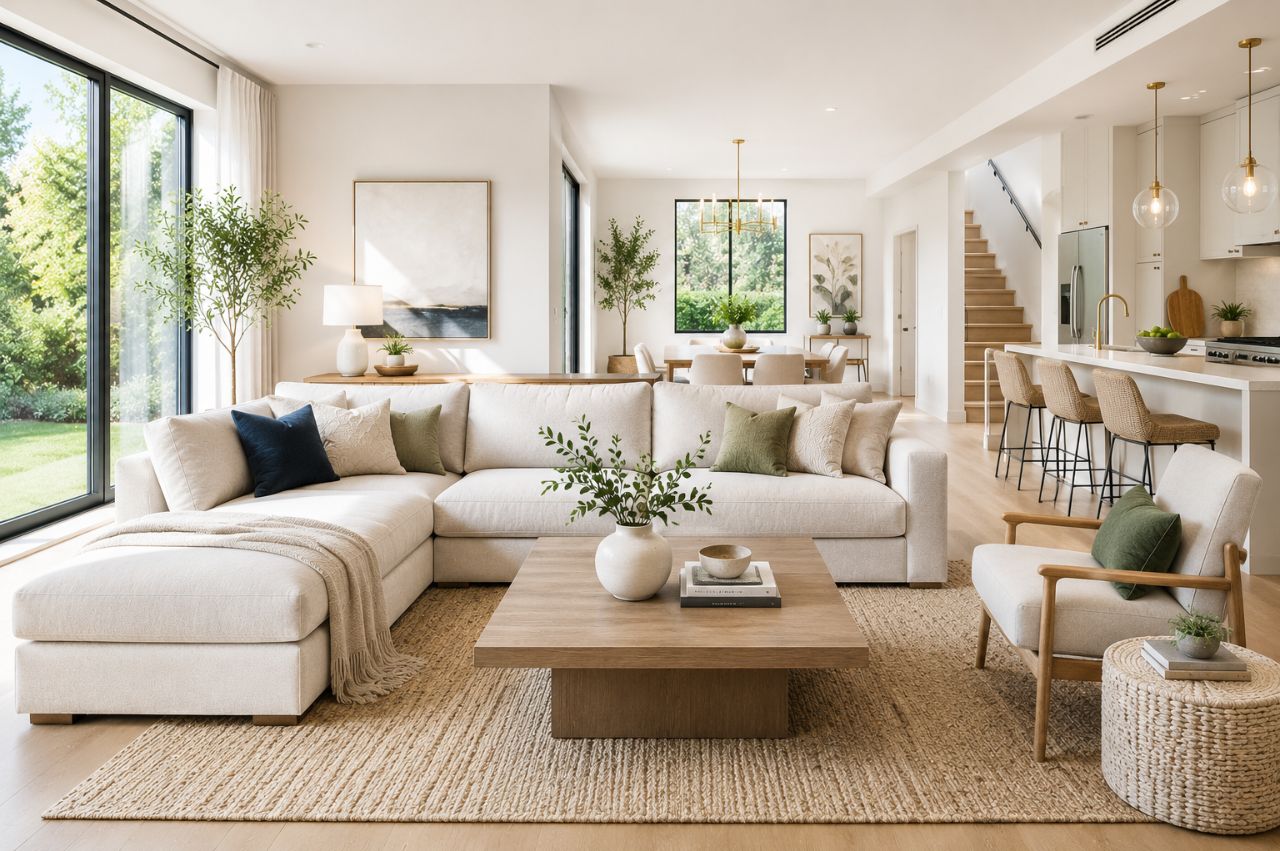
This is one of the most common questions Canadians ask when furnishing their living room and the honest answer is that both are right, depending on what else is in the room. The sectional vs sofa debate is not about which piece is better. It is about which one is better for your specific floor, your household and how you actually use the space. This guide gives you the information to make that call with confidence.
How Do You Decide Between a Sectional and a Sofa?
Start with the room, not the furniture. Before you consider style or comfort, measure the space and think about how traffic moves through it. A sectional defines a zone by anchoring one or two walls. A sofa leaves more of the floor plan open and gives you the flexibility to add other seating around it. If your living room has a clear, contained area for seating, a sectional fills it well. If the room doubles as a thoroughfare or connects to a dining area, a sofa tends to give you more workable options.
When a Sectional Makes More Sense
A sectional is the stronger choice when seating capacity is a priority and the floor plan supports it.
For families, a sectional sofa is hard to beat. It keeps everyone in the same space, handles movie nights without anyone sitting on the floor and fills a larger room in a way that two sofas rarely do as efficiently. An L-shaped sectional in the corner of a living room maximises seating while keeping the centre of the room clear.
Should I buy a sectional or a sofa if I have a smaller space? Counterintuitively, a well-scaled sectional can work better in a compact room than two sofas. A sectional sized to the room fills the available space intentionally rather than leaving awkward gaps. The key is proportion. A sectional that is too large will close a room in entirely. One that is right-sized will make it feel purposefully arranged.
The Triston Sleeper Sectional is a strong example of a sectional built for real Canadian living. It functions as a full sectional sofa and converts to a sleeper for guests, with a modern profile that works in both compact and medium-sized living rooms.
When a Sofa Makes More Sense
A sofa gives you flexibility that a sectional simply cannot match.
If you entertain regularly, a sofa paired with accent chairs creates a more conversational layout than a sectional, where everyone tends to face the same direction. A sofa also lets you rearrange the room as your needs change. Sectionals commit you to one configuration because of their size and shape.
Sectional sofa vs two sofas is another version of this question. Two sofas facing each other create a formal, symmetrical layout that works well for conversation and for rooms with a fireplace or window as the focal point. A single sectional creates a more casual, contained arrangement. Neither is wrong but they produce very different rooms.
The Velmora Upholstered 3-Seater Sofa is a well-proportioned sofa with a gently curved frame and brushed gold arm accents that suits both modern and transitional living rooms. It works as a standalone anchor piece or as part of a paired sofa arrangement.
Modular vs Sectional Sofa: Is There a Difference?
Yes, and it matters. Modular vs sectional sofa comes down to flexibility. A traditional sectional is a fixed configuration, usually L-shaped or U-shaped, that ships as connected pieces and stays that way. A modular sofa is made up of individual pieces that can be rearranged into different layouts as your room or your needs change.
If you move frequently or expect your living room layout to evolve, a modular option gives you considerably more long-term value. If your room is stable and you want a defined seating zone, a traditional sectional is more straightforward and often more affordable.
I-Shaped vs U-Shaped Sectional: Which Layout Works Better?
I-shaped vs U-shaped sectional sofa is a layout question more than a style one.
An I-shaped sectional, essentially a sofa with a chaise on one end, is the most compact sectional format. It suits smaller rooms and works well in rooms where you need the seating to run along one wall without projecting too far into the centre of the space.
A U-shaped sectional wraps around three sides and is designed for large rooms with a dedicated seating zone. It seats more people, creates a stronger sense of enclosure and works well in open-plan spaces where the sectionals themselves define the living area within a larger floor plate. In most Canadian condos and mid-sized homes, an I-shaped or L-shaped configuration is the more practical choice.
Find the Right Seating for Your Living Room at Accents@Home
How to choose a sectional sofa or a sofa ultimately comes down to your room dimensions, your household and how the space is used day to day. For larger families and contained living rooms, a sectional delivers. For flexible layouts and entertaining-focused spaces, a sofa gives you more room to work with. At Accents@Home, both the sofa and sectional collections are built for real Canadian homes. Start with the room, choose the piece that fits it and the rest follows naturally.


