

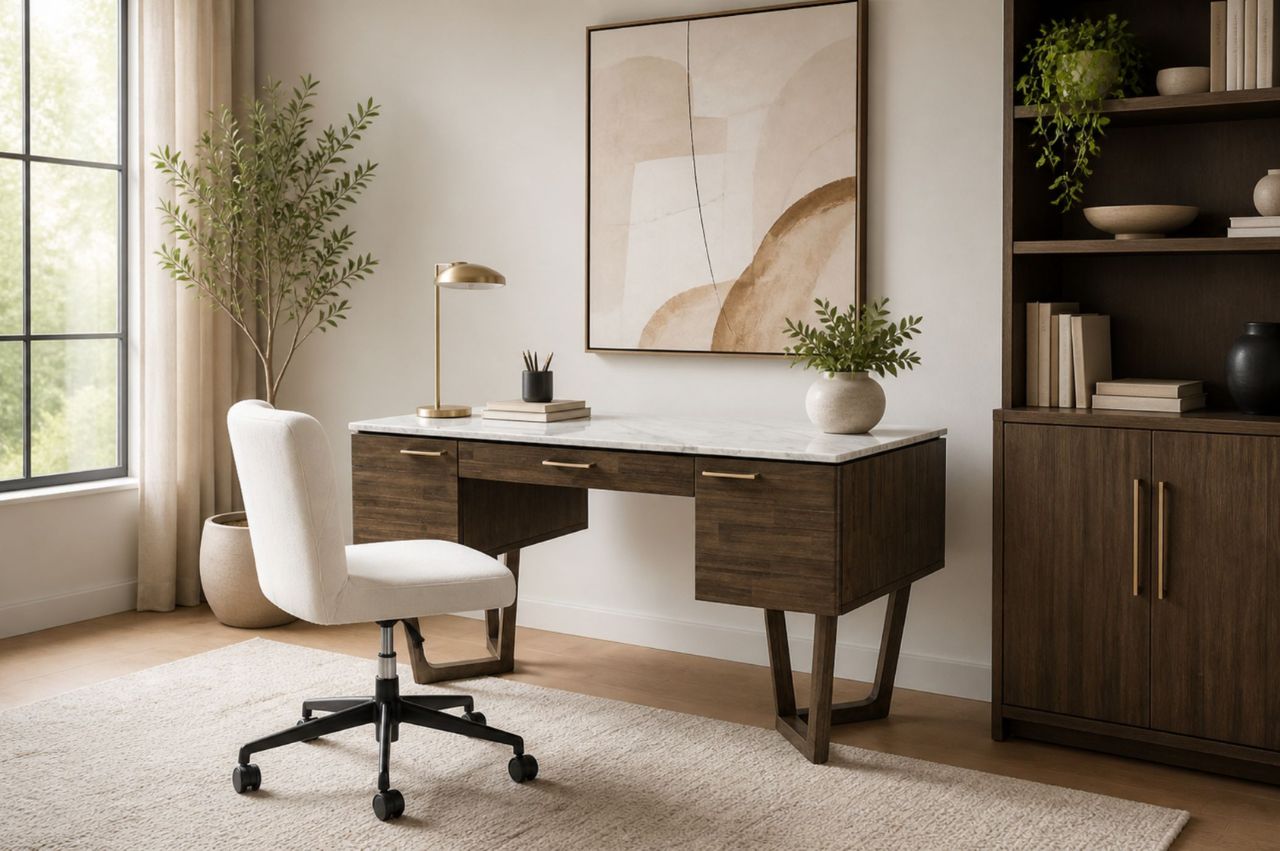
The home office went from a spare room afterthought to one of the most designed spaces in Canadian homes almost overnight. Since remote and hybrid work became the norm, people have invested real time and money into making their workspace feel right.
Pinterest boards were consulted. Colour palettes were chosen. Shelves were styled. And somewhere in that process, a lot of home offices crossed a line that most people do not notice until the room stops feeling like a place where they can actually think.
How the Home Office Became a Designed Space
A few years ago, the home office was wherever the laptop landed. A kitchen table, a corner of the bedroom, occasionally a proper desk if you were lucky.
Today, it is one of the most intentionally designed rooms in the home. People are investing in ergonomic chairs, statement desks, curated bookshelves and carefully chosen colour schemes. Themes are being followed with real commitment.
The dark academia office with leather-bound books and warm lamp light. The minimal Scandinavian setup with clean surfaces and natural wood. The maximalist creative studio with layered art and personal objects on every surface. Each of these works beautifully when done with restraint.
Sign 1: Your Room Has a Theme but No Breathing Room
Committing to a theme is not the problem. Committing to every single element of a theme at once is. The dark academia office that has the desk, the leather chair, the globe, the stack of vintage books, the brass lamp, the framed botanical prints, the dried flowers and the antique clock all in one room is not atmospheric. It is exhausting. When every piece belongs to the same visual language and every surface is filled, the room has no place for the eye to land and rest. That is the beginning of over decorating.
The fix is not abandoning the theme. It is choosing the three or four pieces that carry it best and letting those do the work. A well-chosen desk as the anchor, one strong wall piece and a single shelf styled with intention will always read as more considered than a room where the theme has been applied to every corner.
Sign 2: Your Furniture Does Not Match the Nature of Your Job
One of the most common decorating mistakes that date your home office specifically is choosing furniture for how it looks rather than how it functions in the space. A desk that is too large for the room forces everything else to crowd around it.
A chair that looks striking but offers no real support becomes something you stop using within a week and replace with whatever is functional.
Overdecorating in a home office often shows up in furniture choices that prioritise aesthetics over the actual demands of daily work.
An office chair that supports your posture through a full workday matters more than one that looks good in photos. But what if a chair does both jobs at once?
Similarly, a bookcase that organises your actual books and reference materials serves the room better than one styled entirely with objects that have nothing to do with how you work.
Sign 3: Every Wall Has Something on It
Walls in a home office collect things quickly. A motivational print here. A framed certificate there. A mood board pinned to one corner. A plant shelf on another.
Before long, every wall surface is carrying something, and the room starts to feel like it is closing in. This is one of the clearest signs of an over-decorated house, and it is particularly common in home offices because people treat wall space as free real estate that costs nothing to use.
Good over-decorating correction here means identifying one wall as the feature wall and keeping the others largely clear.
One strong piece of art or a well-arranged shelf on the feature wall creates a focal point. The remaining walls breathe. The room immediately feels larger and more focused. A work lounge setup in the corner of a home office, where there is a clear separation between the desk zone and a more relaxed reading or thinking spot, also helps define the room without adding more to its walls.
What Type of Decor Can Work Well in Your Home Office?
A home office that functions well and looks considered follows a simple principle. Every piece earns its place by doing something specific. The desk is the right size for the room and the work. The chair supports the body throughout the day.
The shelving holds what actually needs to be stored and displayed, not everything that could be. An accent chair in a reading corner adds a layer of comfort and visual warmth without competing with the desk as the room's primary focus.
The walls carry one strong moment and let the rest of the room breathe around it. Natural light is treated as a design element rather than something to be covered. Plants are chosen for the space they occupy rather than for how many can fit on a windowsill.
Redesign Your Home Office with Accents at Home!
The best home offices are not the most decorated ones. They are the ones where every piece was chosen with the room in mind rather than the trend.
At Accents at Home, the range covers everything a home office needs to function well and feel designed at the same time. Whether you are starting from scratch or editing a room that has gone too far, the right furniture makes the process straightforward. Less, chosen well, will always outperform more, chosen quickly.


